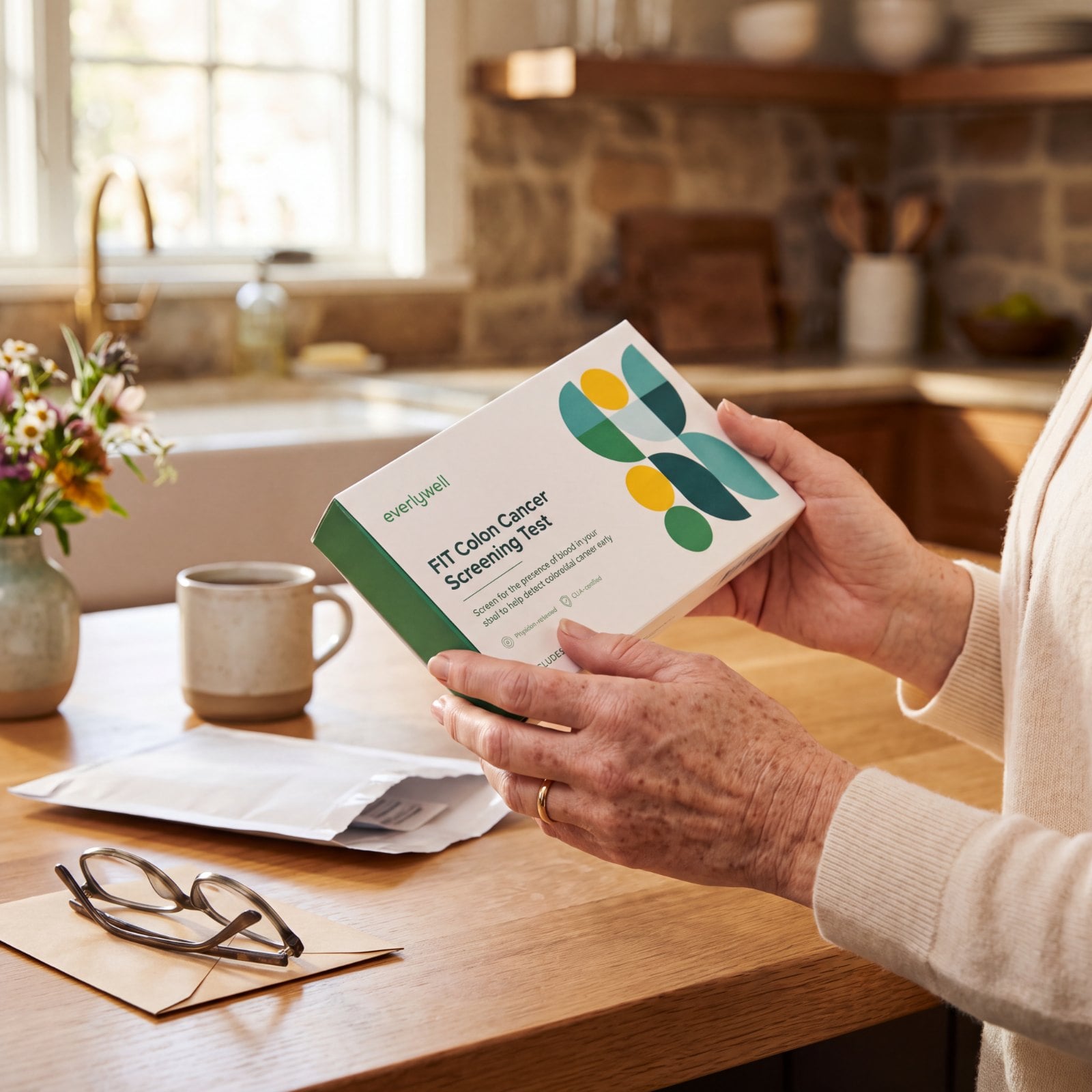
FIT Colon Cancer Screening Test
Screens a stool sample for hidden blood, a sign of colon cancer.
- Free shipping, both ways
- FSA / HSA accepted, or pay over time
- Ships to every state except New York
About this test
Our Fecal Immunochemical Test (FIT) screens for the presence of hidden blood in your stool to help detect early signs of colon cancer. This test is intended for those between the ages of 45-75 or those who have an increased risk for colon cancer (such as family history).
- Measures the presence of blood in your stool
- Stool sample collection

Who should take this test?
The American Cancer Society and US Preventive Services Task Force recommend regular screening for colon cancer starting at age 45 for people at normal risk.
People are at normal risk if they
- Have no personal or family history of colon cancer, including familial disorders such as Lynch syndrome
- Have no personal history of inflammatory bowel diseases such as Crohn’s or ulcerative colitis
- Have never received radiation in the belly area to treat other cancers
Symptoms can include
- Unexplained weight loss
- Changes in stool habits
- Blood in the stool (that’s what FIT screens for)
- Abdominal aches or cramps that do not go away
- The feeling of the bowels not fully emptying
What does this test measure?
This test measures the presence of blood in your stool.
- Hemoglobin in stool
- Because colorectal polyps (which may be precancerous) can leak blood during bowel movements, screening for blood in your stool is a simple, non-invasive way to catch colon cancer early. A positive result does not necessarily mean that you have colon cancer. It simply means that you should discuss the results with your healthcare provider to discuss next steps, which may include a colonoscopy.
What’s in the box
Everything you need to collect your sample and send it back, with free shipping both ways.
Collection paper
Lays across the toilet bowl to catch the sample.
Collection tube
A small tube with a probe in the cap. Dip the probe, seal it, and you are done.
Biohazard bag
The tube goes in here, then into the mailer.
Prepaid return mailer
Addressed to the lab. Drop it in any USPS mailbox, ideally the same day.
Instructions and kit ID
Register the ID online before you collect, so your results reach your account.
Four steps, from your door to your results

- Day 1
Order and check your timing
Order online and your kit ships free. No fasting or diet changes, but wait to collect if you have your period, bleeding hemorrhoids, or blood in your urine.
- Days 2 to 7
Register, collect, and ship
Register your kit ID online, then collect a small stool sample with the collection paper and tube. Seal it in the biohazard bag and mail it back with the prepaid label.
- Days 10 to 14
Get your results
Physician-reviewed results post to your secure account, with a clear negative or positive result for hidden blood in your stool sample.
- After your results
Follow up, then screen again
A positive result doesn’t mean you have colon cancer. Share it with your healthcare provider, who may recommend a colonoscopy. If it’s negative, guidelines suggest a yearly FIT.
This test is intended for adults 45 and older at average risk of colorectal cancer. It’s a screening test, not a diagnosis.
What your results tell you
A normal or abnormal result, and what to do next.
- A clear normal or abnormal result
- An abnormal result means you should follow up with your healthcare provider, who may recommend a colonoscopy
- A reminder of when to screen again
- Results you can share with your healthcare provider
Clinical-grade testing, from the comfort of home.
From the lab to your report, every step of our process meets the gold standard in medical testing.
CLIA-certified labs
Every lab we partner with is certified under the Clinical Laboratory Improvement Amendments, meeting both state and federal standards with regular independent inspections.
We protect your health data
We protect your health data with encryption and do not sell it. Some results must be reported to public health authorities by law. See our Privacy Notice.
Rigorous quality assurance
All partner labs run regular internal quality checks, participate in proficiency testing, and comply with federal and state lab regulations.
Clinician-reviewed reports
Results are reviewed by an independent, licensed clinician.
Related tests
Questions
Common questions.
Anything else, our care team answers by phone, text, or email.
For people who are at average risk of colorectal cancer, the U.S. Preventive Services Task Force (USPSTF), Centers for Disease Control and Prevention (CDC), and the American Cancer Society (ACS), recommend yearly FIT testing for individuals between the ages of 45-75.
This test measures the presence of occult blood in stool as one method of assessing potential colon cancer or precancerous lesions or polyps. This means that conditions or procedures that involve or result in genital or rectal bleeding, including, but not limited to menstruation, diverticulitis, IBS, hemorrhoids, post-colonoscopy or polyp removal, can result in false positive results to this test. Individuals with these conditions are advised to wait until no genital or rectal bleeding is occurring to collect a test sample. Positive results on this test are not a diagnosis of colon or colorectal cancer, and require follow-up with a healthcare professional, where additional testing such as a colonoscopy is generally indicated as the next step. An independent physician will determine whether to authorize your FIT test request, if appropriate. The test is intended for those ages 45-75.
For people above the age of 75, other factors must be considered, such as general health and willingness to undergo intervention should your FIT screening results be positive.
You’re considered to be at average risk if you do not have:
- A family history or predisposition of colon cancer (such as Lynch syndrome or familial adenomatous polyposis)
- A personal history of inflammatory bowel disease (ulcerative colitis or Crohn’s disease)
- A personal history of colorectal cancer, adenomas or other related cancers
- A positive result from another screening method in the last year
The age of initial FIT screening and surveillance intervals are highly dependent on the nature of the risk for individuals who are considered high risk. If any of the above apply to you, it is recommended you follow up with your healthcare provider about when to initiate colorectal cancer screening, what type of screening test is most appropriate, and how frequently you should repeat screening.
This colon screening test is not a replacement for a colonoscopy. The test is designed to show if blood is detected in your stool, which may be associated with colorectal polyps and cancers. False positive and false negative results may occur. Any positive FIT test result should be shared with your healthcare provider and followed up with a colonoscopy. Do not use this test if you have adenomas, inflammatory bowel disease, certain hereditary syndromes, or a personal family history of colorectal cancer. All tests are ordered and reviewed by an independent physician. Individuals age 75+ should follow up with their healthcare provider about the benefits and risks of screening.
The FIT Colon Cancer Screening Test is intended for use by individuals 45 years of age or older. Taking this test prior to the recommended age is outside of the intended use of the product, but is possible. This test measures the presence of occult blood in stool as one method of assessing potential colon cancer or precancerous lesions or polyps. Positive results on this test are not a diagnosis of colon or colorectal cancer, and require follow-up with a healthcare professional, where additional testing such as a colonoscopy is generally indicated as the next step.
Colon or colorectal cancer usually develops slowly over a period of many years. It often begins as a non-cancerous, but abnormal, mass of tissue (called a “polyp”) that grows along the inner lining of the colon or rectum. Polyps can eventually become cancerous, especially a particular kind of colorectal polyp known as an adenoma.
In general, colorectal polyps (meaning found in either your colon or rectum) will not cause symptoms. This is why routine screening is so important, so you can catch colon cancer early and treat it accordingly.
We recommend speaking with your healthcare provider right away if you are experiencing any of the following symptoms:
- Alternating or chronic diarrhea or constipation
- Very thin “pencil” stools
- Persistent urge to have a bowel movement
- Significant weight loss
- New or worsening pain in the abdomen
You do not need to fast or change your diet or any medications prior to testing. However, you should wait to be tested if you are experiencing any of the following:
- Bleeding from hemorrhoids
- Currently menstruating
- Blood in the urine
- Recent GI surgery
- Recent diverticulitis flare
Your FIT Colon Cancer Screening Test results will show you if you are negative or positive for blood in your stool. A positive FIT result does not mean that you have colon cancer, it simply means you need to share the results with your healthcare provider to discuss next steps (which may include a colonoscopy).
Positive results from a FIT Colon Cancer Screening Test should be discussed with your healthcare provider and followed up with additional testing (such as a colonoscopy) to determine the cause of blood in your stool. While the Affordable Care Act requires most health plans to cover colorectal cancer screening tests at no cost to the patient, some insurers may consider a follow-up colonoscopy to be a diagnostic test which may be subject to out-of-pocket costs such as co-pays and deductibles. When scheduling a colonoscopy, it’s helpful to review your health insurance plan for specific details, including whether your healthcare provider is on your insurance company’s list of “in-network” providers. Call your insurance provider to check how much, if anything, you should expect to pay for your colonoscopy and to ask any other coverage-related questions you may have. This can help you avoid surprise costs.
Various types of colorectal cancer screening tests can be performed before a colonoscopy (which is an outpatient procedure done by your physician to look inside your colon and rectum using a flexible tube).
This fecal immunochemical test (FIT) is easy to do, and studies suggest it is more sensitive compared to the guaiac-based fecal occult blood test (gFOBT) for detecting colon cancer. Both of these colon cancer screening tests are known as FOBTs (fecal occult blood test) because they are intended to measure very small amounts of blood in your stool, which is invisible to the eye. The Everlywell FIT Colon Cancer Screening Test is a convenient, non-invasive screening option you can use from the comfort of home. There are no restrictions to use this screening method; sample collection simply requires that you send a small stool sample back to the lab.
A guaiac-based fecal occult blood test (gFOBT) also detects blood in the stool but may also detect blood from further up the digestive tract, like from the stomach. A FIT test is more specific to detecting blood from the lower part of the gastrointestinal tract. Certain foods or drugs can also affect your results such as aspirin, ibuprofen, red meats, and vitamin C supplements, which may need to be avoided prior to taking this type of stool test for colorectal cancer screening.
A stool DNA (or FIT-DNA) test specifically looks for mutations of polyp DNA in your stool. The stool DNA test typically requires you to send an actual stool sample back to the lab for processing, but collection can still be performed at home. However, studies have shown that the specificity (true negative rate) is lower than that of FIT, meaning there have been more positive results where a follow-up colonoscopy was negative.
If you are unsure which screening method is right for you, please follow up with your healthcare provider who can discuss your medical history in more detail.
Yes, this test is available to New York residents. This test is sold directly by PWN Laboratory LLC, a CLIA-certified clinical laboratory. Everlywell provides administrative and fulfillment services on behalf of the laboratory. Your testing experience, results quality, and customer support remain unchanged.